
£25.00
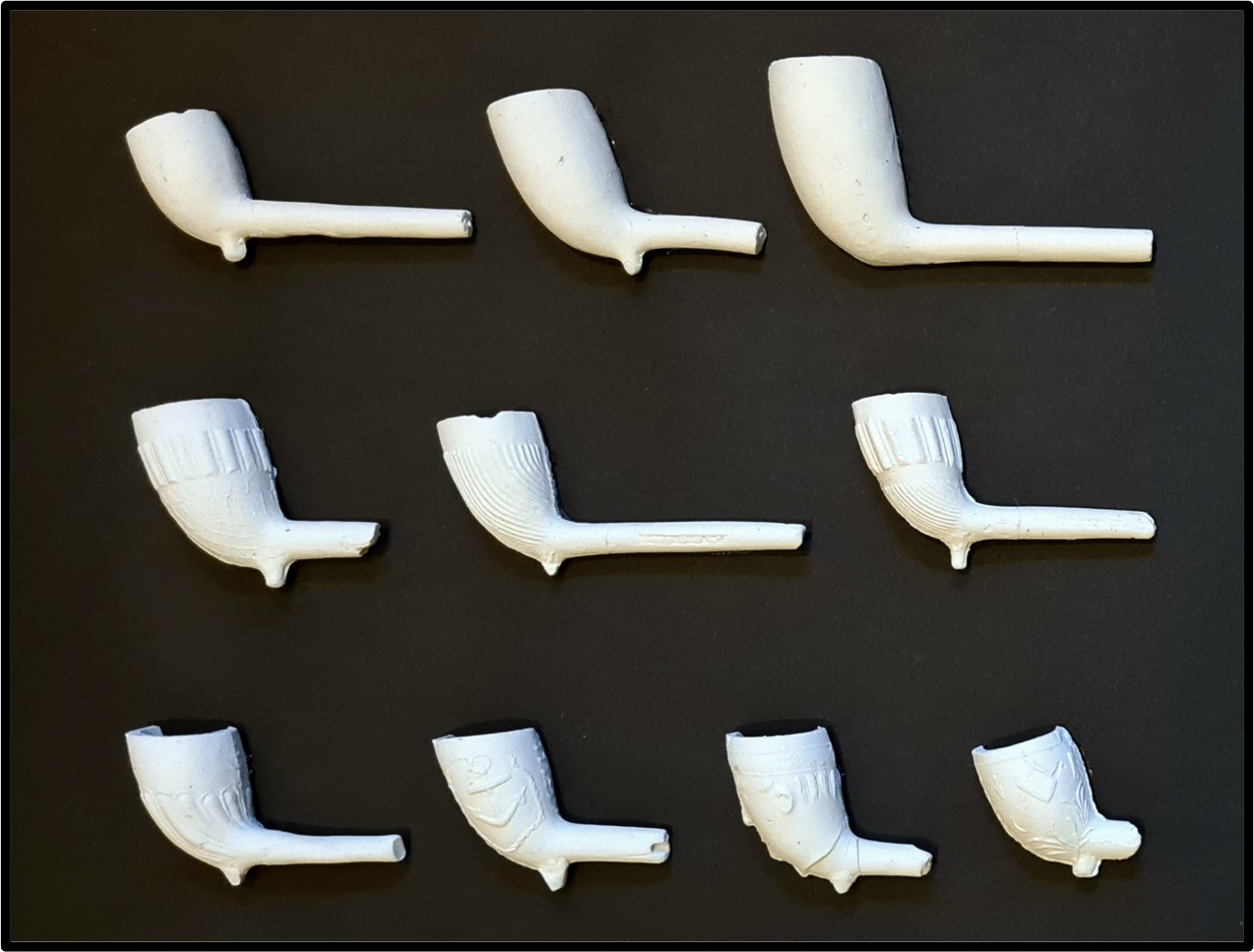
Clay pipes were the most common way of consuming tobacco in the 1800s, and remined widely used until the early 1900s. They were cheap to make and so could easily be replaced if they were broken or became clogged with carbon. There were a number of clay pipe makers in Glasgow, but one of the most prominent was William Murray, who opened the Caledonian Clay Pipe Works at Garngad Hill in the East End of Glasgow in 1832. His pipes came in a number of different designs, but most were stamped with the name Murray on one side of the stem and Glasgow on the other, making them easy to identify, and they have been found on archaeological sites as far away as the United States, Canada and Australia.
The pipes in this photograph were recovered from the side of the Forth and Clyde Canal in the Maryhill area of Glasgow in June 2023. They were most likely part of a large shipment rom the mid-1800s destined for export. They would have started their journey on the Monkland Canal (now the M8 Motorway) before entering the Forth and Clyde Canal on their way to Bowling and the open waters of the Firth of Clyde where they’d have been transferred onto a sea-going vessel. Unfortunately, while passing through Maryhill, the shipment was lost, most likely due to a fire on board the boat carrying them, and then ended up on the bottom of the canal. Sometime later, they were dredged out of the canal and dumped on the edge of the towpath. Finally, during path renovations in 2023, the pipe were uncovered and brought to the surface.
The print itself is 7.25 inches by 9 inches (18.5 cm by 23cm), and it comes mounted in a white 1.5 inch (3.5 cm) mount with a total size of 10 inches by 12 inches (25.5 cm by 30.5cm).
20 in stock
Description
William Murray Clay Pipes A4 Mounted Print
We offer free 2nd class shipping by Royal Mail to UK addresses on all prints.
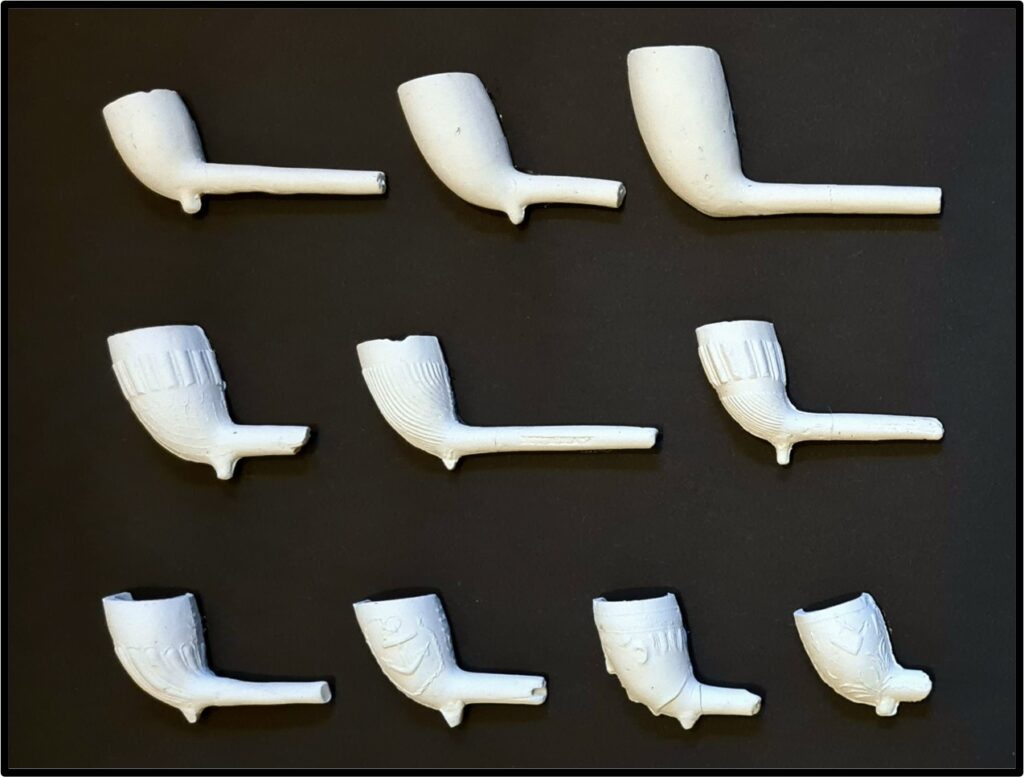
Clay pipes were the most common way of consuming tobacco in the 1800s, and remined widely used until the early 1900s. They were cheap to make and so could easily be replaced if they were broken or became clogged with carbon. There were a number of clay pipe makers in Glasgow, but one of the most prominent was William Murray, who opened the Caledonian Clay Pipe Works at Garngad Hill in the East End of Glasgow in 1832. His pipes came in a number of different designs, but most were stamped with the name Murray on one side of the stem and Glasgow on the other, making them easy to identify, and they have been found on archaeological sites as far away as the United States, Canada and Australia.
The pipes in this photograph were recovered from the side of the Forth and Clyde Canal in the Maryhill area of Glasgow in June 2023. They were most likely part of a large shipment rom the mid-1800s destined for export. They would have started their journey on the Monkland Canal (now the M8 Motorway) before entering the Forth and Clyde Canal on their way to Bowling and the open waters of the Firth of Clyde where they’d have been transferred onto a sea-going vessel. Unfortunately, while passing through Maryhill, the shipment was lost, most likely due to a fire on board the boat carrying them, and then ended up on the bottom of the canal. Sometime later, they were dredged out of the canal and dumped on the edge of the towpath. Finally, during path renovations in 2023, the pipe were uncovered and brought to the surface.
The print itself is 7.25 inches by 9 inches (18.5 cm by 23cm), and it comes mounted in a white 1.5 inch (3.5 cm) mount with a total size of 10 inches by 12 inches (25.5 cm by 30.5cm).
Additional information
| Weight | 0.5 kg |
|---|---|
| Dimensions | 35 × 35 × 2 cm |
Related products
-

Glasgow University Collage Print (Mounted Size 10 inch by 12 inch)
£25.00 Add to cart -

Glasgow University In The Snow Christmas Card (A6-Sized)
£3.00 Add to cart -

Glasgow’s Tenement Tiles Print (Mounted Size 10 inch by 12 inch)
£25.00 Add to cart -

The Glasgow Penguins Print (Mounted Size 10 inch by 12 inch)
£25.00 Add to cart